







1. 薬物治療は「いつから」始めるべき?開始タイミングの判断基準
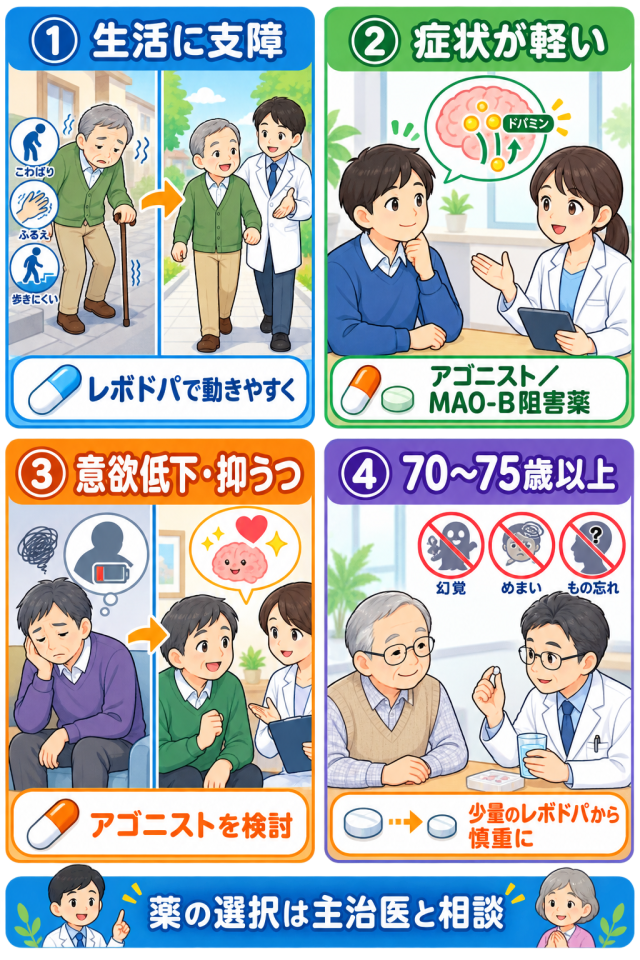
① 運動症状が生活に支障をきたしている場合
速やかに効果の最も強い**「レボドパ(L-ドパ)製剤」**から治療を開始するのが原則です 。速やかに動ける状態を作り、QOLを維持することが最優先されます。
② 支障は軽度だが、薬を開始したい場合(若年・転倒リスクが低い場合など)
L-ドパの開始を少し遅らせたい、あるいはまだ症状が軽微である場合は、脳内のドーパミン受容体を刺激する**「ドパミン受容体作動薬(アゴニスト)」や、ドーパミンの分解を抑える「MAO-B(マオビー)阻害薬」**から開始する選択肢があります 。
特にMAO-B阻害薬(ラサギリンなど)は、早期から導入することで、その後の本格的なドーパミン補充療法の開始時期を遅らせることができるというエビデンス(科学的根拠)が示されています。
③ 精神症状(抑うつや意欲低下)が先行している場合
パーキンソン病では、手の震えなどの運動不調が現れる何年も前から、意欲低下や抑うつ(活気が出ない)といった非運動症状が出ることがわかっています 。このような「動く能力はあるはずなのに、意欲が起きなくて動けない」というケースでは、脳内のD3受容体(感情や意欲に関わる領域)の刺激作用が期待できる「ドパミンアゴニスト」から先行して導入することがあります。
④ 高齢発症(概ね70歳〜75歳以上)の場合
高齢の患者様の場合、幻覚や妄想、物忘れなどの「認知機能低下」や「起立性低血圧(立ちくらみ)」などの副作用が出やすくなります 。そのため、高齢者では副作用を避けるためにアゴニストや抗コリン薬などの使用を極力避け、安全性が高く切れ味の良い「レボドパ製剤」の少量投与から慎重にスタートするのが一般的です
参考文献
[1] Sy and Fernandez (2020)
Pharmacological Treatment of Early Motor Manifestations of Parkinson Disease (PD). Neurotherapeutics : the journal of the American Society for Experimental NeuroTherapeutics.
https://pubmed.ncbi.nlm.nih.gov/32935299/
[2] Bie et al. (2020)
Initiation of pharmacological therapy in Parkinson’s disease: when, why, and how. The Lancet. Neurology.
https://pubmed.ncbi.nlm.nih.gov/32171387/
[3] Thobois and Broussolle (2007)
[Initial management of Parkinson disease]. Presse medicale (Paris, France : 1983).
https://pubmed.ncbi.nlm.nih.gov/17296476/
[4] Löhle and Reichmann (2011)
Controversies in neurology: why monoamine oxidase B inhibitors could be a good choice for the initial treatment of Parkinson’s disease. BMC neurology.
https://pubmed.ncbi.nlm.nih.gov/21939547/
[5] Isaacson and Hauser (2009)
Improving symptom control in early Parkinson’s disease. Therapeutic advances in neurological disorders.
https://pubmed.ncbi.nlm.nih.gov/21180628/
[6] NICE (2025)
Foslevodopa–foscarbidopa for treating advanced Parkinson’s with motor symptoms. 3 Committee discussion. nice.org.uk.
https://www.nice.org.uk/guidance/ta934/chapter/3-Committee-discussion
[7] Marsili et al. (2017)
Treatment Strategies in Early Parkinson’s Disease. International review of neurobiology.
https://pubmed.ncbi.nlm.nih.gov/28554414/
[8] Suzuki et al. (2020)
Adherence to treatment guideline recommendations for Parkinson’s disease in Japan: A longitudinal analysis of a nationwide medical claims database between 2008 and 2016. PloS one.
https://pubmed.ncbi.nlm.nih.gov/32330133/
[9] Neurology (2021)
Practice Guideline Update Summary: Treatment of Motor Symptoms in Early Parkinson Disease: Report of the Guideline Subcommittee of the American Academy of Neurology. Neurology.
https://www.aan.com/Guidelines/home/GetGuidelineContent/1043
[10] Neurology (2021)
Practice Guideline Update Summary: Treatment of Motor Symptoms in Early Parkinson Disease: Report of the Guideline Subcommittee of the American Academy of Neurology. Neurology.
https://www.aan.com/Guidelines/home/GetGuidelineContent/1043
[11] PubMed (2015)
Parkinson’s disease: fewer treatment withdrawals with levodopa. Prescrire international.
https://pubmed.ncbi.nlm.nih.gov/26788582/
[12] Gray et al. (2014)
Long-term effectiveness of dopamine agonists and monoamine oxidase B inhibitors compared with levodopa as initial treatment for Parkinson’s disease (PD MED): a large, open-label, pragmatic randomised trial. Lancet (London, England).
https://pubmed.ncbi.nlm.nih.gov/24928805/
[13] Neurology (2021)
Practice Guideline Update Summary: Treatment of Motor Symptoms in Early Parkinson Disease: Report of the Guideline Subcommittee of the American Academy of Neurology. Neurology.
https://www.aan.com/Guidelines/home/GetGuidelineContent/1043
[14] Neurology (2021)
Practice Guideline Update Summary: Treatment of Motor Symptoms in Early Parkinson Disease: Report of the Guideline Subcommittee of the American Academy of Neurology. Neurology.
https://www.aan.com/Guidelines/home/GetGuidelineContent/1043
[15] Binde et al. (2021)
Time until Need for Levodopa among New Users of Dopamine Agonists or MAO-B Inhibitors. Parkinson’s disease.
https://pubmed.ncbi.nlm.nih.gov/34306611/
[16] Caslake et al. (2009)
Monoamine oxidase B inhibitors versus other dopaminergic agents in early Parkinson’s disease. The Cochrane database of systematic reviews.
https://pubmed.ncbi.nlm.nih.gov/19821381/
[17] Stowe et al. (2008)
Dopamine agonist therapy in early Parkinson’s disease. The Cochrane database of systematic reviews.
https://pubmed.ncbi.nlm.nih.gov/18425954/
[18] Hauser (2010)
Early pharmacologic treatment in Parkinson’s disease. The American journal of managed care.
https://pubmed.ncbi.nlm.nih.gov/20297870/
[19] Hauser (2009)
New considerations in the medical management of early Parkinson’s disease: impact of recent clinical trials on treatment strategy. Parkinsonism & related disorders.
https://pubmed.ncbi.nlm.nih.gov/20082983/
[20] Holloway et al. (2004)
Pramipexole vs levodopa as initial treatment for Parkinson disease: a 4-year randomized controlled trial. Archives of neurology.
https://pubmed.ncbi.nlm.nih.gov/15262734/
2. パーキンソン病治療薬の「効果」とそれぞれの特徴
パーキンソン病の治療薬は非常に多岐にわたり、それぞれ脳内やお腹(末梢)で異なる働きをします 。これらの組み合わせ(さじ加減)によって、1日の運動症状を安定させていきます。
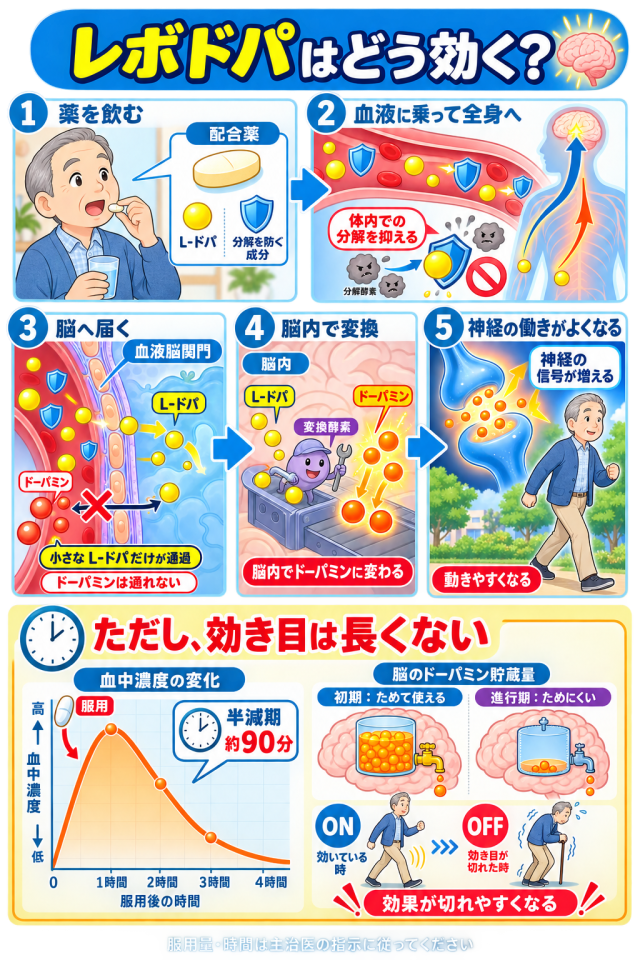
A. レボドパ(L-ドパ)配合薬(ゴールドスタンダード)
・代表的な薬剤:メネジット、マドパー、ハルロピ、ドパストンなど
・作動メカニズム:減少してしまったドーパミンそのものを脳外から直接補給する、最も効果が強く即効性のある主薬です。L-ドパが脳(血液脳関門)を通過して中枢に届き、ドーパミンに変換されることで劇的に動きが改善します 。
・課題:L-ドパの血中半減期(体内から半減する時間)は約90分と非常に短いため [cite: 66, 71]、病気が進行して脳内にドーパミンを貯蔵しておく能力が衰えてくると、薬の効果がすぐに切れてしまうようになります
B. ドパミン受容体作動薬(アゴニスト)
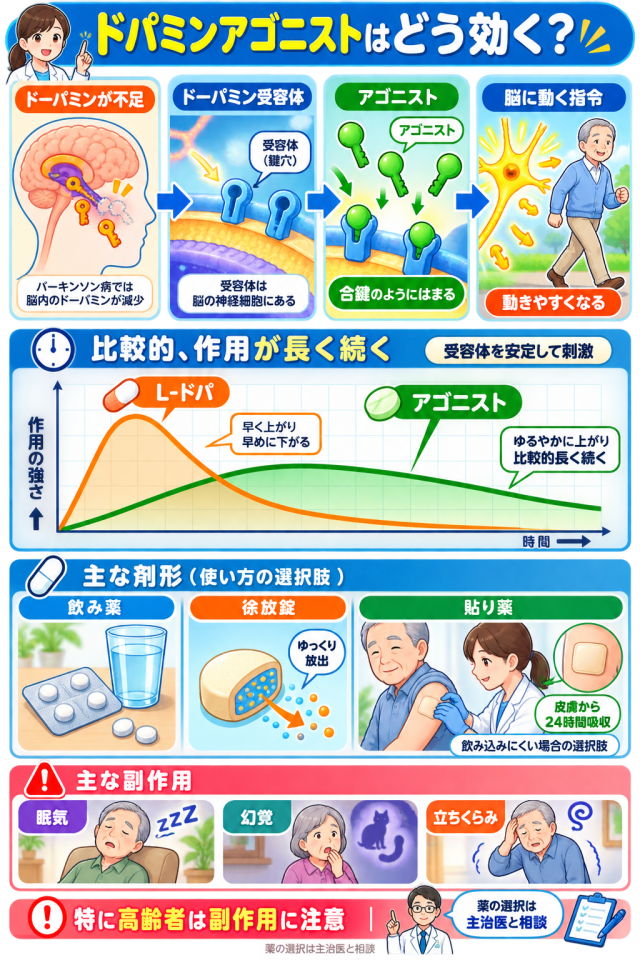
・代表的な薬剤:ビ・シフロール(プラミペキソール)、レキップ(ロピニロール)、ニュープロパッチ(ロチゴチン:貼り薬)など 。
・作動メカニズム:脳内のドーパミン受容体に鍵穴のようにはまり込み、ドーパミンに似た指令を伝えることで運動機能を改善します 。
・特徴:L-ドパに比べて効果が長持ちするため、血中濃度を安定させやすく(CDS:持続的ドパミン刺激)、後述する進行期の合併症を防ぐために早期から併用されるトレンドがあります 。嚥下(飲み込み)が悪い高齢者には、皮膚から安定して吸収される「貼り薬(貼付薬)」も非常によく用いられます。
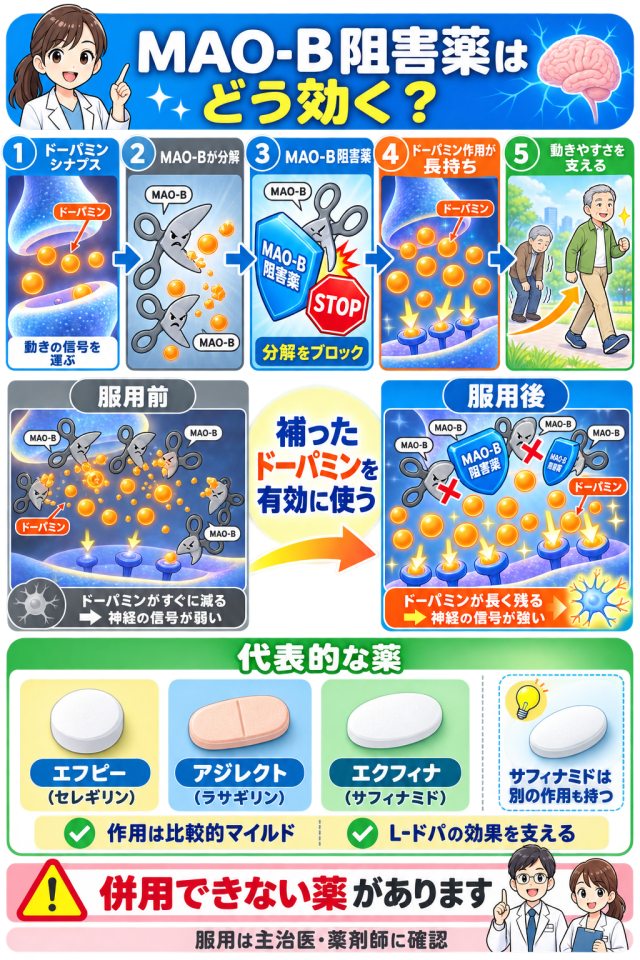
C. MAO-B(マオビー)阻害薬
・代表的な薬剤:エフピー(セレギリン)、アジレクト(ラサギリン)、エクフィナ(サフィナミド)
・作動メカニズム:脳内でドーパミンを分解してしまう酵素(MAO-B)の働きをブロックし、せっかく補給したドーパミンが再利用されやすく(長持ち)なるようサポートします 。
・特徴:非常にマイルドで安定した効果があり、調整がしやすいため近年の処方数が非常に増えています
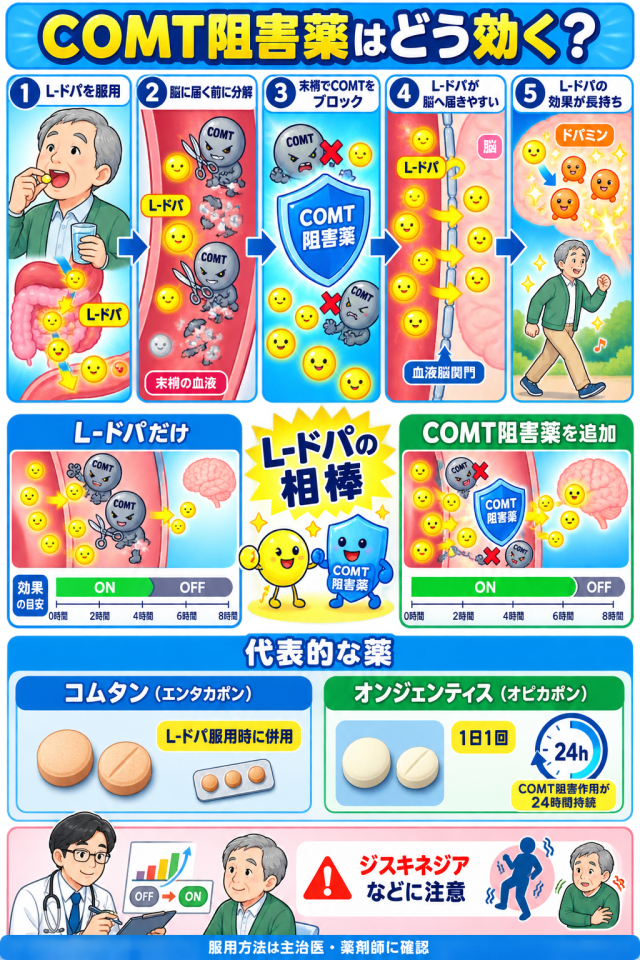
D. COMT(コムト)阻害薬
・代表的な薬剤:コムタン(エンタカポン)、オンジェンティス(オピカポン)
・作動メカニズム:L-ドパが脳に届く前に、お腹(血液中)で分解されてしまうのを防ぐ「相棒」のようなお薬です 。
・特徴:必ずL-ドパ製剤と一緒に服用します 。特に「オピカポン」は1日1回の服用で24時間効果が持続するため、患者様の服薬負担を大きく減らすことができます。
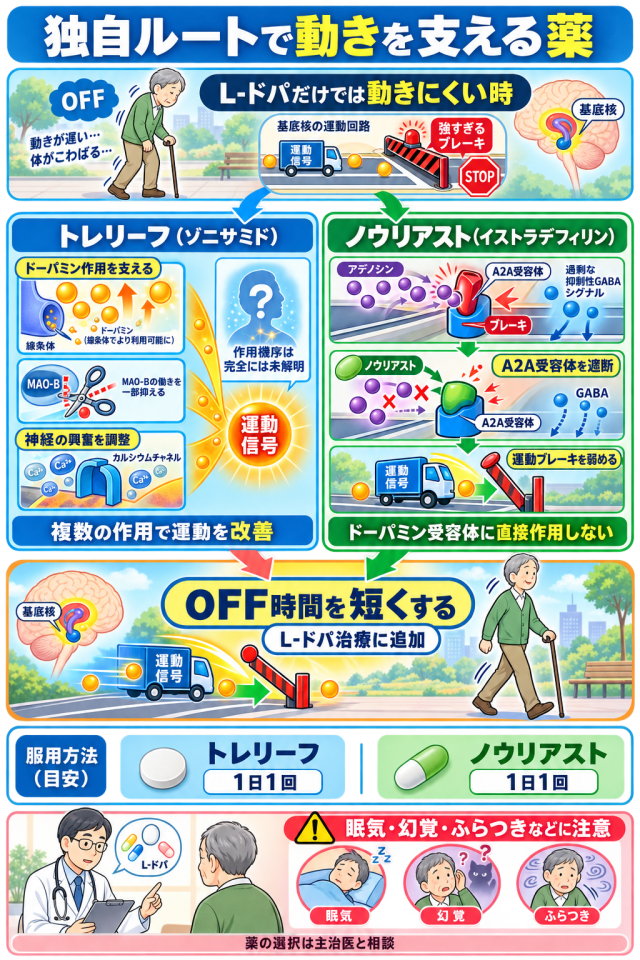
E. 非ドパミン系製剤(トレリーフ、ノウリアスト)
・代表的な薬剤:トレリーフ(ゾニサミド)、ノウリアスト(イストラデフィリン)
・作動メカニズム:ドパミン受容体に直接作用するのではなく、脳の運動ブレーキ(アデノシン受容体など)を弱めるなど、独自のルートで体の動きをスムーズにします。
・特徴:ドーパミン系薬剤に特有の「急激な血圧低下」や「強い幻覚」が出にくいため、高齢の方や、ドパミン製剤をこれ以上増やせない進行期の方に併用しやすいという大きなメリットがあります
参考文献
[1] Muranova and Shanina (2023)
Levodopa/Carbidopa/Entacapone Combination Therapy. StatPearls Publishing.
https://www.ncbi.nlm.nih.gov/books/n/statpearls/article-159939/
[2] Gandhi and Saadabadi (2023)
Levodopa (L-Dopa). StatPearls Publishing.
https://www.ncbi.nlm.nih.gov/books/n/statpearls/article-23965/
[3] Djukic et al. (2026)
[Pharmacokinetics and pharmacodynamics of anti-Parkinson drugs in geriatric patients : Key for optimization of treatment]. Zeitschrift fur Gerontologie und Geriatrie.
https://pubmed.ncbi.nlm.nih.gov/41711898/
[4] Müller (2024)
Clinical pharmacokinetics of levodopa and relevant add-on therapies for Parkinson’s disease. Expert opinion on drug metabolism & toxicology.
https://pubmed.ncbi.nlm.nih.gov/39523848/
[5] Fabbri et al. (2022)
COMT Inhibitors in the Management of Parkinson’s Disease. CNS drugs.
https://pubmed.ncbi.nlm.nih.gov/35217995/
[6] Ferraiolo and Hermans (2023)
The complex molecular pharmacology of the dopamine D_{2} receptor: Implications for pramipexole, ropinirole, and rotigotine. Pharmacology & therapeutics.
https://pubmed.ncbi.nlm.nih.gov/36958527/
[7] Cánovas et al. (2014)
Dopaminergic agonists in Parkinson’s disease. Neurologia (Barcelona, Spain).
https://pubmed.ncbi.nlm.nih.gov/21724302/
[8] Barone (2003)
Clinical strategies to prevent and delay motor complications. Neurology.
https://pubmed.ncbi.nlm.nih.gov/14504375/
[9] Bonuccelli et al. (2009)
Role of dopamine receptor agonists in the treatment of early Parkinson’s disease. Parkinsonism & related disorders.
https://pubmed.ncbi.nlm.nih.gov/20123557/
[10] Stocchi (2009)
The therapeutic concept of continuous dopaminergic stimulation (CDS) in the treatment of Parkinson’s disease. Parkinsonism & related disorders.
https://pubmed.ncbi.nlm.nih.gov/20083012/
[11] Reichmann (2009)
Transdermal delivery of dopamine receptor agonists. Parkinsonism & related disorders.
https://pubmed.ncbi.nlm.nih.gov/20123566/
[12] Chen et al. (2009)
Transdermal rotigotine: a clinically innovative dopamine-receptor agonist for the management of Parkinson’s disease. Pharmacotherapy.
https://pubmed.ncbi.nlm.nih.gov/19947805/
[13] Dezsi and Vecsei (2017)
Monoamine Oxidase B Inhibitors in Parkinson’s Disease. CNS & neurological disorders drug targets.
https://pubmed.ncbi.nlm.nih.gov/28124620/
[14] Alborghetti and Nicoletti (2019)
Different Generations of Type-B Monoamine Oxidase Inhibitors in Parkinson’s Disease: From Bench to Bedside. Current neuropharmacology.
https://pubmed.ncbi.nlm.nih.gov/30160213/
[15] Bhidayasiri and Suansanae (2026)
A dual timeline of safinamide effects in Parkinson’s disease: mechanistic rationale and clinical implications. Frontiers in neurology.
https://pubmed.ncbi.nlm.nih.gov/42318242/
[16] Binde et al. (2018)
A multiple treatment comparison meta-analysis of monoamine oxidase type B inhibitors for Parkinson’s disease. British journal of clinical pharmacology.
https://pubmed.ncbi.nlm.nih.gov/29847694/
[17] Regensburger et al. (2023)
Clinical benefit of MAO-B and COMT inhibition in Parkinson’s disease: practical considerations. Journal of neural transmission (Vienna, Austria : 1996).
https://pubmed.ncbi.nlm.nih.gov/36964457/
[18] Asano et al. (2023)
Safety comparisons among monoamine oxidase inhibitors against Parkinson’s disease using FDA adverse event reporting system. Scientific reports.
https://pubmed.ncbi.nlm.nih.gov/37935702/
[19] Najib (2001)
Entacapone: a catechol-O-methyltransferase inhibitor for the adjunctive treatment of Parkinson’s disease. Clinical therapeutics.
https://pubmed.ncbi.nlm.nih.gov/11440283/
[20] Dingemanse (2000)
Issues important for rational COMT inhibition. Neurology.
https://pubmed.ncbi.nlm.nih.gov/11147507/
[21] Fabbri et al. (2018)
Opicapone for the treatment of Parkinson’s disease: A review of a new licensed medicine. Movement disorders : official journal of the Movement Disorder Society.
https://pubmed.ncbi.nlm.nih.gov/30264443/
[22] Svetel et al. (2018)
Pharmacokinetic drug evaluation of opicapone for the treatment of Parkinson’s disease. Expert opinion on drug metabolism & toxicology.
https://pubmed.ncbi.nlm.nih.gov/29345156/
3. 必ず知っておくべき「副作用」と長期経過の課題
パーキンソン病の薬は、動けるようになる素晴らしいメリットがある一方で、脳や全身の様々な部位に作用するため、以下のような副作用(合併症)に注意する必要があります。
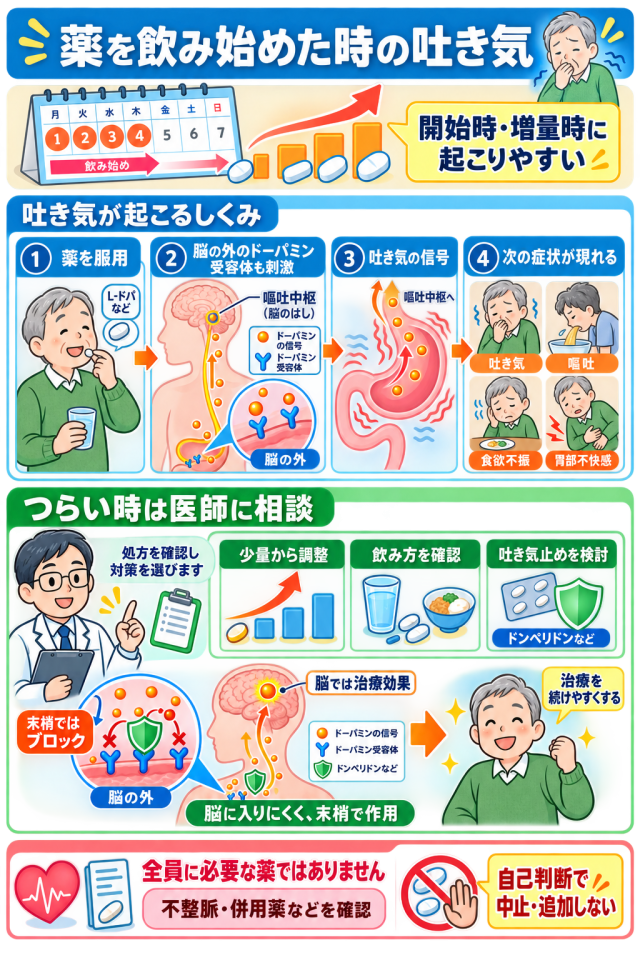
① 飲み始め(初期)に出やすい副作用:消化器症状
・対策:この初期トラブルで内服を諦めてしまわないよう、通常は処方の初めから、脳には入らずに胃腸にだけ効いて吐き気を止めるお薬(ドンペリドンなど)や胃腸運動改善薬を一緒に飲むことで、安全に回避することができます。
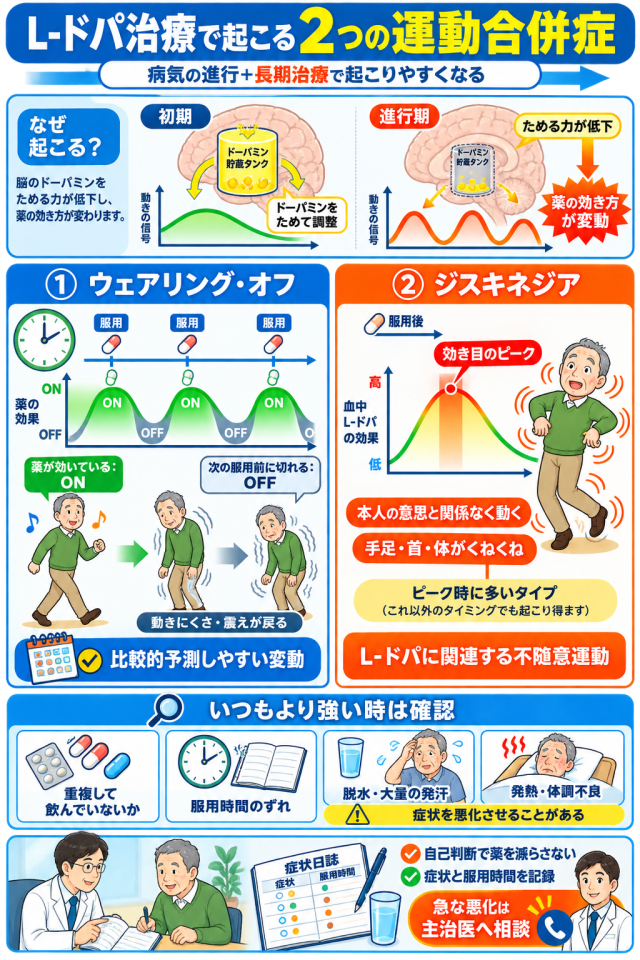
② 薬を5年〜10年以上使い続けると現れる「運動合併症」
・ウェアリング・オフ現象: 次の薬を飲む時間になる前に効果が切れてしまい、急に体が重く動かなくなったり、震えが戻ったりします(予測可能な症状の変動) 。
・ジスキネジア(不随意運動): 病気そのものの症状ではなく、「L-ドパの血中濃度がピークのとき」などに脳のドーパミンが過剰に刺激され、本人の意思とは無関係に手足や首がくねくねと勝手に動いてしまう現象です 。
・注意点:いつもよりジスキネジアが強く出ている場合は、「脱水」や「大量の発汗」によって急激に血中濃度が上がってしまっている可能性や、薬の重複内服(服薬ミス)などが疑われます
③ 精神系・神経系・その他の副作用(特にアゴニスト使用時)
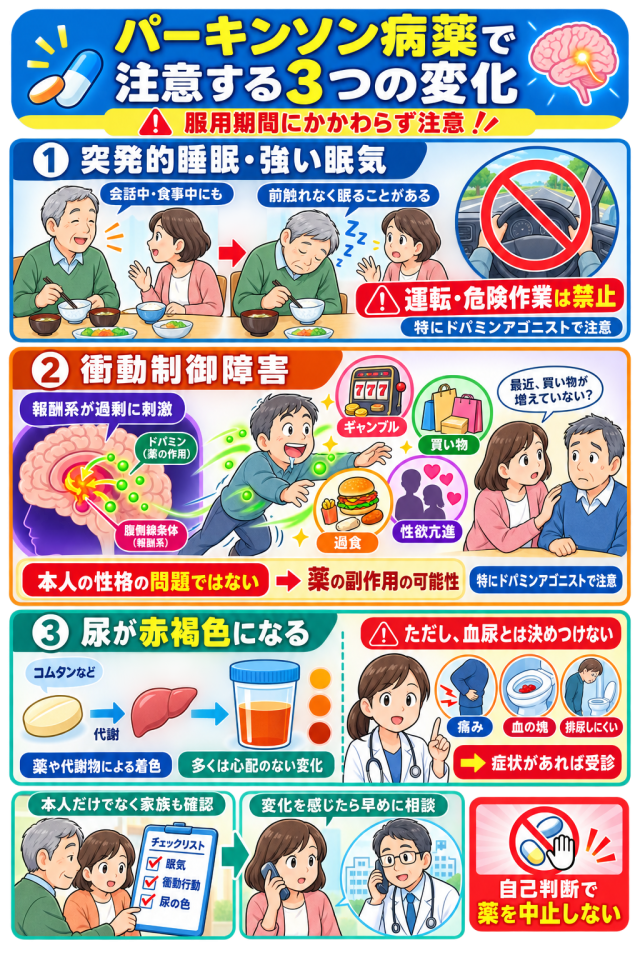
・突発性睡眠と強い眠気:前触れもなく、食事中や会話中に突然ガクッと眠り込んでしまうことがあります(車の運転は厳禁となります)。
・衝動制御障害:快感に関わる脳の神経系(腹側線条体・側座核など、元々ドーパミンが足りている場所)が薬によって過剰に刺激されることで、ギャンブル依存、買い物依存、過食、性欲亢進など「自分をコントロールできなくなる衝動」が現れることがあります。これは本人の性格の変化ではなく、明確な「薬の副作用」です 。
・尿の色が変わる:COMT阻害薬(コムタン等)を服用すると、薬の代謝物によって尿がオレンジ色や赤褐色に変わります。血尿と勘違いして驚かれる方が多いですが、無害ですので安心してください
参考文献
[1] Lertxundi et al. (2013)
Domperidone in Parkinson’s disease: a perilous arrhythmogenic or the gold standard?. Current drug safety.
https://pubmed.ncbi.nlm.nih.gov/23656449/
[2] Ramprasad et al. (2018)
Parkinson’s Disease and Current Treatments for Its Gastrointestinal Neurogastromotility Effects. Current treatment options in gastroenterology.
https://pubmed.ncbi.nlm.nih.gov/30361854/
[3] Pasricha et al. (2024)
Management of Gastrointestinal Symptoms in Parkinson’s Disease: A Comprehensive Review of Clinical Presentation, Workup, and Treatment. Journal of clinical gastroenterology.
https://pubmed.ncbi.nlm.nih.gov/38260966/
[4] Gandhi and Saadabadi (2023)
Levodopa (L-Dopa). StatPearls Publishing.
https://www.ncbi.nlm.nih.gov/books/n/statpearls/article-23965/
[5] Januel et al. (2025)
Use and misuse of domperidone in patients living with Parkinson disease in France. Fundamental & clinical pharmacology.
https://pubmed.ncbi.nlm.nih.gov/40062736/
[6] Renoux et al. (2016)
Ventricular tachyarrhythmia and sudden cardiac death with domperidone use in Parkinson’s disease. British journal of clinical pharmacology.
https://pubmed.ncbi.nlm.nih.gov/27062307/
[7] Bacchi et al. (2017)
Domperidone for Hypotension in Parkinson’s Disease: A Systematic Review. Journal of Parkinson’s disease.
https://pubmed.ncbi.nlm.nih.gov/29103053/
[8] Damiens et al. (2026)
Gastroparesis in Parkinson’s disease: Diagnostic and clinical implications for optimizing pharmacological treatment. Journal of Parkinson’s disease.
https://pubmed.ncbi.nlm.nih.gov/42268283/
[9] L. (2022)
ACG Clinical Guideline: Gastroparesis. The American Journal of Gastroenterology.
https://journals.lww.com/ajg/Fulltext/2022/08000/ACG_Clinical_Guideline__Gastroparesis.15.aspx
[10] Ivan et al. (2021)
Gastro-intestinal dysfunctions in Parkinson’s disease (Review). Current opinion in biotechnology.
https://pubmed.ncbi.nlm.nih.gov/34447476/
[11] Jost (2010)
Gastrointestinal dysfunction in Parkinson’s Disease. Journal of the neurological sciences.
https://pubmed.ncbi.nlm.nih.gov/19717168/
[12] Kim et al. (2020)
Motor complications in Parkinson’s disease: 13-year follow-up of the CamPaIGN cohort. Movement disorders : official journal of the Movement Disorder Society.
https://pubmed.ncbi.nlm.nih.gov/31965629/
[13] Manson et al. (2012)
Levodopa-induced-dyskinesias clinical features, incidence, risk factors, management and impact on quality of life. Journal of Parkinson’s disease.
https://pubmed.ncbi.nlm.nih.gov/23938226/
[14] López et al. (2010)
Motor complications in Parkinson’s disease: ten year follow-up study. Movement disorders : official journal of the Movement Disorder Society.
https://pubmed.ncbi.nlm.nih.gov/20931632/
[15] Gerpen et al. (2006)
Levodopa-associated dyskinesia risk among Parkinson disease patients in Olmsted County, Minnesota, 1976-1990. Archives of neurology.
https://pubmed.ncbi.nlm.nih.gov/16476808/
[16] Tse (2006)
Optimizing pharmacotherapy: strategies to manage the wearing-off phenomenon. Journal of the American Medical Directors Association.
https://pubmed.ncbi.nlm.nih.gov/17948614/
[17] Pahwa and Lyons (2009)
Levodopa-related wearing-off in Parkinson’s disease: identification and management. Current medical research and opinion.
https://pubmed.ncbi.nlm.nih.gov/19228103/
[18] Hutny et al. (2021)
Current Knowledge on the Background, Pathophysiology and Treatment of Levodopa-Induced Dyskinesia-Literature Review. Journal of clinical medicine.
https://pubmed.ncbi.nlm.nih.gov/34640395/
[19] Kim et al. (2019)
Chronological View of Peak and Diphasic Dyskinesia, Wearing Off and Freezing of Gait in Parkinson’s Disease. Journal of Parkinson’s disease.
https://pubmed.ncbi.nlm.nih.gov/31498128/
[20] Frequin et al. (2024)
Long-Term Follow-Up of the LEAP Study: Early Versus Delayed Levodopa in Early Parkinson’s Disease. Movement disorders : official journal of the Movement Disorder Society.
https://pubmed.ncbi.nlm.nih.gov/38644623/
[21] Choi and Horner (2023)
Dopamine Agonists. StatPearls Publishing.
https://www.ncbi.nlm.nih.gov/books/n/statpearls/article-20658/
[22] Singh and Parmar (2023)
Pramipexole. StatPearls Publishing.
https://www.ncbi.nlm.nih.gov/books/n/statpearls/article-27592/
[23] Perez-Lloret and Rascol (2010)
Dopamine receptor agonists for the treatment of early or advanced Parkinson’s disease. CNS drugs.
https://pubmed.ncbi.nlm.nih.gov/20932066/
[24] Barake et al. (2018)
MANAGEMENT OF ENDOCRINE DISEASE: Impulse control disorders in patients with hyperpolactinemia treated with dopamine agonists: how much should we worry?. European journal of endocrinology.
https://pubmed.ncbi.nlm.nih.gov/30324793/
[25] Grall-Bronnec et al. (2018)
Dopamine Agonists and Impulse Control Disorders: A Complex Association. Drug safety.
https://pubmed.ncbi.nlm.nih.gov/28861870/
[26] Nirenberg (2013)
Dopamine agonist withdrawal syndrome: implications for patient care. Drugs & aging.
https://pubmed.ncbi.nlm.nih.gov/23686524/
[27] Muranova and Shanina (2023)
Levodopa/Carbidopa/Entacapone Combination Therapy. StatPearls Publishing.
https://www.ncbi.nlm.nih.gov/books/n/statpearls/article-159939/
[28] Waters (2000)
Practical issues with COMT inhibitors in Parkinson’s disease. Neurology.
https://pubmed.ncbi.nlm.nih.gov/11147511/
[29] Kaakkola (2000)
Clinical pharmacology, therapeutic use and potential of COMT inhibitors in Parkinson’s disease. Drugs.
https://pubmed.ncbi.nlm.nih.gov/10882160/
[30] Muranova and Shanina (2023)
Levodopa/Carbidopa/Entacapone Combination Therapy. StatPearls Publishing.
https://www.ncbi.nlm.nih.gov/books/n/statpearls/article-159939/
[31] Drugs.com (2024)
Entacapone. drugs.com.
https://www.drugs.com/mtm/entacapone.html
[32] Willman and Tadi (2023)
Tolcapone. StatPearls Publishing.
https://www.ncbi.nlm.nih.gov/books/n/statpearls/article-30239/
[33] Drugs.com (2024)
Carbidopa, entacapone, and levodopa. drugs.com.
https://www.drugs.com/mtm/carbidopa-entacapone-and-levodopa.html
[34] Brooks (2004)
Safety and tolerability of COMT inhibitors. Neurology.
https://pubmed.ncbi.nlm.nih.gov/14718679/
[35] Chong and Mersfelder (2000)
Entacapone. The Annals of pharmacotherapy.
https://pubmed.ncbi.nlm.nih.gov/10981253/
4. 薬物代謝の負担(サビ)と、薬だけに頼らない「土井治療院」の根本改善アプローチ
・グリンパティック・システムの促進:頭部への鍼治療(電気鍼など)は、睡眠中に脳の有害な異常タンパク質(αシヌクレインなど)を洗い流す「グリンパティック・システム」の働きを科学的に後押しすることが報告されています 。不眠を和らげることで、夜間の脳内クリーニング機能を高めます 。
・胃腸機能の向上による吸収安定化:胃腸の動きが低下して便秘が慢性化していると、せっかく飲んだお薬がうまくお腹で吸収されず、「薬が効かない(ノーオン・ディレイドオン現象)」の原因になります 。鍼治療でお腹を刺激し、胃酸分泌や蠕動(ぜんどう)運動を高めることで、お腹の炎症を抑え、薬が最もスムーズに吸収されるお腹のベースを整えます。
② 自律神経パワーの回復と「脳の可塑性」の再起動
自律神経が乱れ、脳が「今、体は危険な状態だ(交感神経過緊張・シャットダウン)」と判断している状態では、いくらハードな運動をしても運動効果が定着せず、神経の繋がりを書き換える「脳の可塑性」は働きません 。 鍼治療によって迷走神経を刺激し、体をリラックス(安心・安全モード)に導いた上で、併設の機能回復ジム「REBRUSH(リブラッシュ)」にてリハビリをおこなうことで、最小限のドーパミン量でも驚くほど効率的に、滑らかに動ける体へと書き換えていくことができます

結びに:薬を賢く使い、自分の体と対話する

参考文献
[1] Bosco et al. (2006)
Elevated levels of oxidized cholesterol metabolites in Lewy body disease brains accelerate alpha-synuclein fibrilization. Nature chemical biology.
https://pubmed.ncbi.nlm.nih.gov/16565714/
[2] Ghosh et al. (2021)
α-synuclein aggregates induce c-Abl activation and dopaminergic neuronal loss by a feed-forward redox stress mechanism. Progress in neurobiology.
https://pubmed.ncbi.nlm.nih.gov/33951536/
[3] Scudamore and Ciossek (2018)
Increased Oxidative Stress Exacerbates α-Synuclein Aggregation In Vivo. Journal of neuropathology and experimental neurology.
https://pubmed.ncbi.nlm.nih.gov/29718367/
[4] Hattoria et al. (2009)
Toxic effects of dopamine metabolism in Parkinson’s disease. Parkinsonism & related disorders.
https://pubmed.ncbi.nlm.nih.gov/19131041/
[5] Bisaglia et al. (2007)
Kinetic and structural analysis of the early oxidation products of dopamine: analysis of the interactions with alpha-synuclein. The Journal of biological chemistry.
https://pubmed.ncbi.nlm.nih.gov/17395592/
[6] Perfeito et al. (2012)
Revisiting oxidative stress and mitochondrial dysfunction in the pathogenesis of Parkinson disease–resemblance to the effect of amphetamine drugs of abuse. Free radical biology & medicine.
https://pubmed.ncbi.nlm.nih.gov/22967820/
[7] Levin et al. (2011)
Generation of ferric iron links oxidative stress to α-synuclein oligomer formation. Journal of Parkinson’s disease.
https://pubmed.ncbi.nlm.nih.gov/23934922/
[8] Ren et al. (2026)
How cytochrome P450 enzymes in humans are involved in Parkinson’s disease: a literature review. Neuroscience.
https://pubmed.ncbi.nlm.nih.gov/41730497/
[9] Li et al. (2024)
A crazy trio in Parkinson’s disease: metabolism alteration, α-synuclein aggregation, and oxidative stress. Molecular and cellular biochemistry.
https://pubmed.ncbi.nlm.nih.gov/38625515/
[10] Yu et al. (2026)
Impaired brain-gut circuit for gut motility dysfunction in mouse models of Parkinson’s disease. Cell reports.
https://pubmed.ncbi.nlm.nih.gov/42611706/
[11] Li et al. (2023)
Electroacupuncture for motor dysfunction and constipation in patients with Parkinson’s disease: a randomised controlled multi-centre trial. EClinicalMedicine.
https://pubmed.ncbi.nlm.nih.gov/36691434/
[12] Li et al. (2019)
Efficacy of electroacupuncture for the treatment of constipation in Parkinson’s disease: study protocol for a multicentre randomised controlled trial. BMJ open.
https://pubmed.ncbi.nlm.nih.gov/31780587/
[13] Zhang et al. (2023)
Acupuncture for Parkinson’s disease-related constipation: current evidence and perspectives. Frontiers in neurology.
https://pubmed.ncbi.nlm.nih.gov/37719758/
[14] Li et al. (2024)
Acupuncture for constipation in Parkinson’s disease: A systematic review and meta-analysis of randomized controlled trials. Medicine.
https://pubmed.ncbi.nlm.nih.gov/39029044/
[15] Li et al. (2023)
Efficacy of acupuncture for the treatment of Parkinson’s disease-related constipation (PDC): A randomized controlled trial. Frontiers in neuroscience.
https://pubmed.ncbi.nlm.nih.gov/36866329/
[16] Shen et al. (2022)
Electroacupuncture Modulates 5-HT_{4R}-Mediated cAMP/PKA Signaling to Improve Intestinal Motility Disorders in a Thy1-αSyn Parkinson’s Mouse Model. Evidence-based complementary and alternative medicine : eCAM.
https://pubmed.ncbi.nlm.nih.gov/36337584/
[17] Goldman et al. (2020)
The Glymphatic System and Pain. Medical acupuncture.
https://pubmed.ncbi.nlm.nih.gov/33362890/
[18] Liu et al. (2025)
Acupuncture versus sham acupuncture in the treatment of insomnia for patients with Parkinson’s disease: a randomized controlled clinical trial. BMC complementary medicine and therapies.
https://pubmed.ncbi.nlm.nih.gov/40684211/
[19] Lin et al. (2024)
Effects of acupuncture on sleep quality in patients with Parkinson’s disease: A systematic review and meta-analysis. Clinical rehabilitation.
https://pubmed.ncbi.nlm.nih.gov/38043930/
[20] Yan et al. (2024)
Acupuncture and Sleep Quality Among Patients With Parkinson Disease: A Randomized Clinical Trial. JAMA network open.
https://pubmed.ncbi.nlm.nih.gov/38922617/
[21] Cui et al. (2026)
Acupuncture effects on non-motor symptoms of Parkinson’s disease (sleep, mood, and fatigue): a systematic review and meta-analysis. Frontiers in neurology.
https://pubmed.ncbi.nlm.nih.gov/42180219/
[22] Zang et al. (2025)
Acupuncture modulates the microbiota-gut-brain axis: a new strategy for Parkinson’s disease treatment. Frontiers in aging neuroscience.
https://pubmed.ncbi.nlm.nih.gov/40851666/
[23] Gao et al. (2024)
Acupuncture Treatment of Autonomic Nervous Dysfunction in Patients with Parkinson’s Disease: A Narrative Review. Medical acupuncture.
https://pubmed.ncbi.nlm.nih.gov/39309401/
[24] Zeng and Zhao (2016)
Effect of Acupuncture on the Motor and Nonmotor Symptoms in Parkinson’s Disease–A Review of Clinical Studies. CNS neuroscience & therapeutics.
https://pubmed.ncbi.nlm.nih.gov/26843036/
パーキンソン病を根本から変える:土井治療院の統合的アプローチについて詳しくはこちら
この記事に関する関連記事
- パーキンソン病と鉄分の関係|脳に鉄が蓄積する仕組みと食事との違い
- パーキンソン病で甘いものは控えるべき?糖化・AGEsとの関係と食事の工夫
- パーキンソン病を公表した有名人・芸能人まとめ
- パーキンソン病の症状とは?
- パーキンソン病に鍼(はり)治療は効果がある?「脳のゴミ掃除」と「自律神経」を整える科学的メカニズム
- パーキンソン病の原因となる食べ物は?「脳」ではなく「腸」をターゲットにした最新予防食事法
- パーキンソン病の初期症状とは?「手が震える」より前に気づくべきサインと根本からの予防策
- 『パーキンソン病になりやすい性格とは?「真面目で頑張りすぎる人」が注意したい脳の仕組みを専門家が解説』
- パーキンソン病の原因とは?~最先端研究で見えてきた「共犯説」とは
お電話ありがとうございます、
土井治療院でございます。