







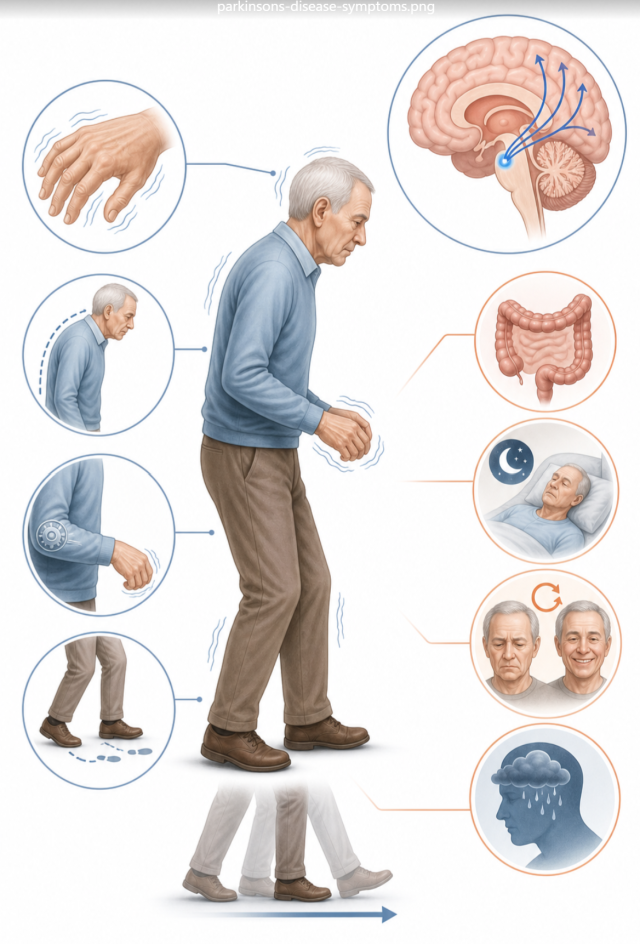
パーキンソン病の「症状」を一望:運動症状と非運動症状の全体像
パーキンソン病は「手の震え(振戦)」「体が固い(筋固縮)」「動きが遅い・少ない(無動・寡動)」といった運動症状がよく知られていますが、実はそれだけではありません。便秘、立ちくらみ、発汗異常、頻尿・夜間尿、睡眠の乱れ、抑うつ・不安、嗅覚低下、慢性のだるさや痛みなど、いわゆる自律神経や情動に関わる“非運動症状”が多面的に現れます。私たちの臨床現場の実感としても、日常生活で困りやすいのは運動と非運動が絡み合った困りごとで、たとえば「朝起きてから動き出すまでに時間がかかる(運動)」「そのうえ立ち上がるとフラッとする(自律神経)」「夜は眠りが浅く日中眠い(睡眠)」のように、1日のリズム全体が揺さぶられる形で進行します。
パーキンソン病は脳内のドーパミン神経の変性だけでなく、腸の神経や自律神経系、嗅覚に関わる経路など、全身のネットワークに変化が広がる“全身性の神経変性疾患”です。そのため「運動器の病気」と考えると見落としが生まれやすく、早期から非運動症状に目を向けることが、ご本人のQOL(生活の質)を守る近道になります。本記事では、代表的な運動症状の見分け方に加え、自律神経症状の起きるメカニズム、早期から気づけるサイン、受診の目安と診断の流れ、生活でできる対策まで、臨床データと実体験に基づいて網羅的に解説します。
この記事のポイント
・典型的な運動症状だけでなく、非運動(自律神経・睡眠・気分・嗅覚)症状が重要です。
・当院での客観評価では、パーキンソン病の方の“自律神経のパワー”が例外なく低下していました。
・「年齢のせい」と思いがちな便秘や立ちくらみ、睡眠の異常が早期サインになることがあります。
代表的な運動症状:無動・筋固縮・振戦・姿勢反射障害を見分ける
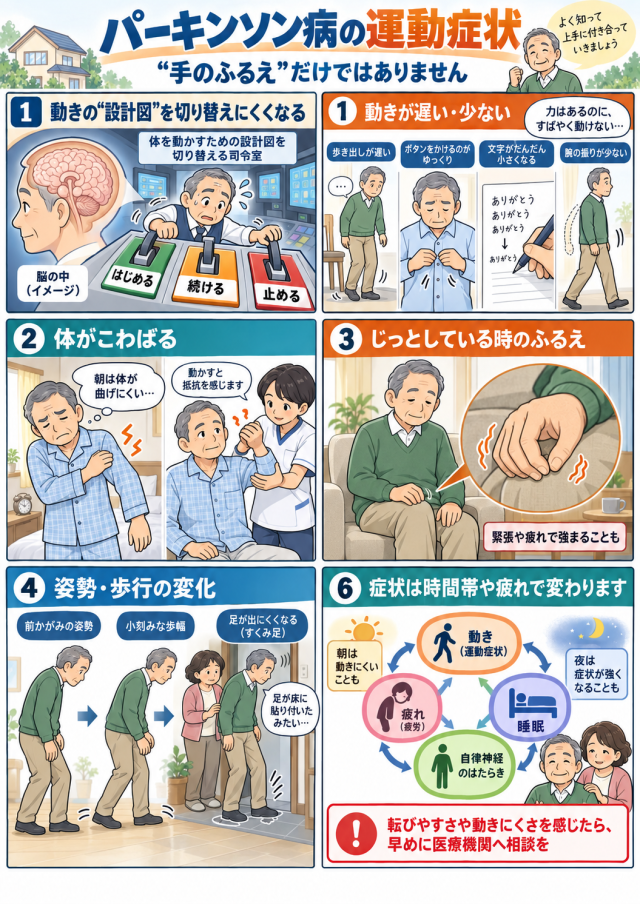
パーキンソン病の運動症状は、単に“手が震える病気”では説明しきれません。動きの設計図(運動プログラム)を素早く切り替えられなくなることで、全身の「はじめる」「続ける」「止める」がぎこちなくなります。
無動・寡動(動きが遅い/少ない)
・特徴:歩き出しに時間がかかる、服のボタンを留めるのが遅い、字が次第に小さくなる(小字症)、顔の表情が乏しく“仮面様顔貌”に見える、声が小さく単調になる。
・ポイント:左右差が出やすく、片側の腕振りが減るのが早期のヒントです。単なる筋力低下とは異なり、力を出せるのに“すばやい反復”が苦手になります。
筋固縮(こわばり)
・特徴:関節を動かすときに常に抵抗がある“鉛管様”の硬さ。検者が手首や肘を動かすと、カクカクと段階的な抵抗(歯車様)を感じることも。
・ポイント:朝の着替えや家事で「関節が硬い」「体が曲げにくい」と感じます。ストレッチで一時的に軽くなっても、再び戻るのが特徴です。
振戦(ふるえ)
・特徴:手を膝に置いた安静時に出やすい“ピルロール(丸薬丸め)”様の振戦。緊張や疲労で強くなり、動作中は目立たないことも。
・ポイント:コップを持つと震える本態性振戦と異なり、じっとしているときに強く、片側優位で始まることが多いです。
姿勢反射障害・歩行障害
・特徴:前かがみ、すり足、小刻み歩行、方向転換が苦手、後ろに引かれると踏ん張りづらい。ドアの前や狭い場所で“足が床に貼り付く”ように止まるフリーズ現象も。
・ポイント:転倒リスクにつながるため、早めのリハビリ介入と住環境調整が重要です。
これらの運動症状は日内変動しやすく、朝や疲労時に強まることがあります。運動症状の度合いは、他の非運動症状(睡眠・自律神経)の乱れと相互に影響し合うため、全体を一つの「サーキット」として把握する視点が欠かせません。
参考文献
参考文献
[1] Jankovic (2008)
Parkinson’s disease: clinical features and diagnosis. Journal of neurology, neurosurgery, and psychiatry.
https://pubmed.ncbi.nlm.nih.gov/18344392/
[2] Erro and Stamelou (2017)
The Motor Syndrome of Parkinson’s Disease. International review of neurobiology.
https://pubmed.ncbi.nlm.nih.gov/28554410/
[3] Zafar and Yaddanapudi (2023)
Parkinson Disease. StatPearls Publishing.
https://www.ncbi.nlm.nih.gov/books/n/statpearls/article-26674/
[4] Ali and Morris (2015)
Parkinson’s disease: chameleons and mimics. Practical neurology.
https://pubmed.ncbi.nlm.nih.gov/25253895/
[5] Zafar and Yaddanapudi (2023)
Parkinson Disease. StatPearls Publishing.
https://www.ncbi.nlm.nih.gov/books/n/statpearls/article-26674/
[6] Moustafa et al. (2016)
Motor symptoms in Parkinson’s disease: A unified framework. Neuroscience and biobehavioral reviews.
https://pubmed.ncbi.nlm.nih.gov/27422450/
[7] Hess and Hallett (2017)
The Phenomenology of Parkinson’s Disease. Seminars in neurology.
https://pubmed.ncbi.nlm.nih.gov/28511251/
[8] Shrimanker et al. (2022)
Parkinsonism. StatPearls Publishing.
https://www.ncbi.nlm.nih.gov/books/n/statpearls/article-26681/
[9] Broussolle et al. (2007)
Contribution of Jules Froment to the study of parkinsonian rigidity. Movement disorders : official journal of the Movement Disorder Society.
https://pubmed.ncbi.nlm.nih.gov/17443696/
[10] Ferreira-Sánchez et al. (2020)
Quantitative Measurement of Rigidity in Parkinson´s Disease: A Systematic Review. Sensors (Basel, Switzerland).
https://pubmed.ncbi.nlm.nih.gov/32041374/
[11] Fung et al. (2000)
Objective quantification of resting and activated parkinsonian rigidity: a comparison of angular impulse and work scores. Movement disorders : official journal of the Movement Disorder Society.
https://pubmed.ncbi.nlm.nih.gov/10634241/
[12] Park et al. (2011)
Analysis of viscoelastic properties of wrist joint for quantification of parkinsonian rigidity. IEEE transactions on neural systems and rehabilitation engineering : a publication of the IEEE Engineering in Medicine and Biology Society.
https://pubmed.ncbi.nlm.nih.gov/21075739/
[13] Asci et al. (2023)
Rigidity in Parkinson’s disease: evidence from biomechanical and neurophysiological measures. Brain : a journal of neurology.
https://pubmed.ncbi.nlm.nih.gov/37018058/
[14] Falletti et al. (2025)
Cogwheel rigidity in Parkinson’s disease: Clinical, biomechanical and neurophysiological features. Neurobiology of disease.
https://pubmed.ncbi.nlm.nih.gov/40447199/
[15] Shrimanker et al. (2022)
Parkinsonism. StatPearls Publishing.
https://www.ncbi.nlm.nih.gov/books/n/statpearls/article-26681/
[16] Mayo Clinic (2024)
Parkinson’s disease. Mayo Clinic.
https://www.mayoclinic.org/diseases-conditions/parkinsons-disease/symptoms-causes/syc-20376055
[17] PubMed (2007)
Distinguishing the signs and motor symptoms of Parkinson’s disease. Nursing older people.
https://pubmed.ncbi.nlm.nih.gov/27741829/
[18] Zafar and Yaddanapudi (2023)
Parkinson Disease. StatPearls Publishing.
自律神経症状はなぜ起こる?当院データで見る「自律神経のパワー低下」
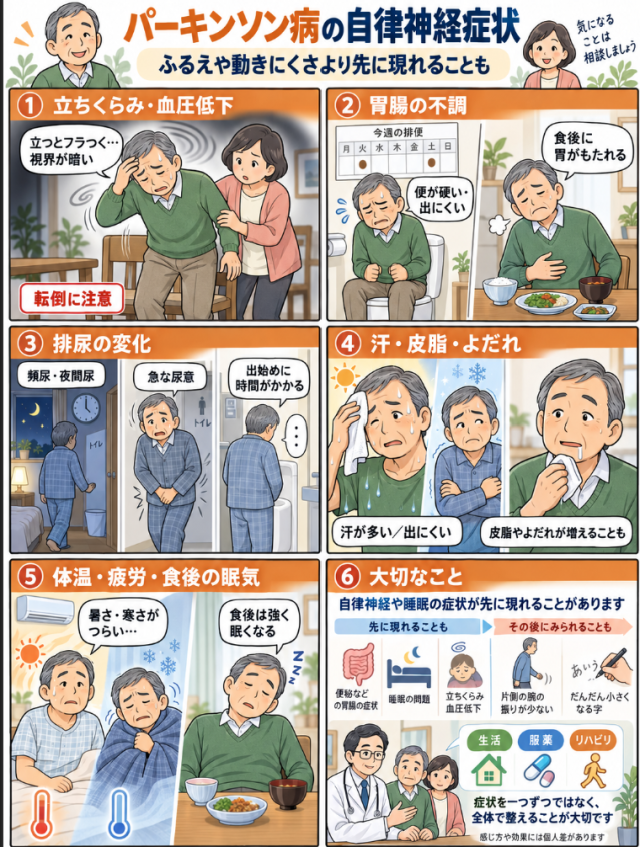
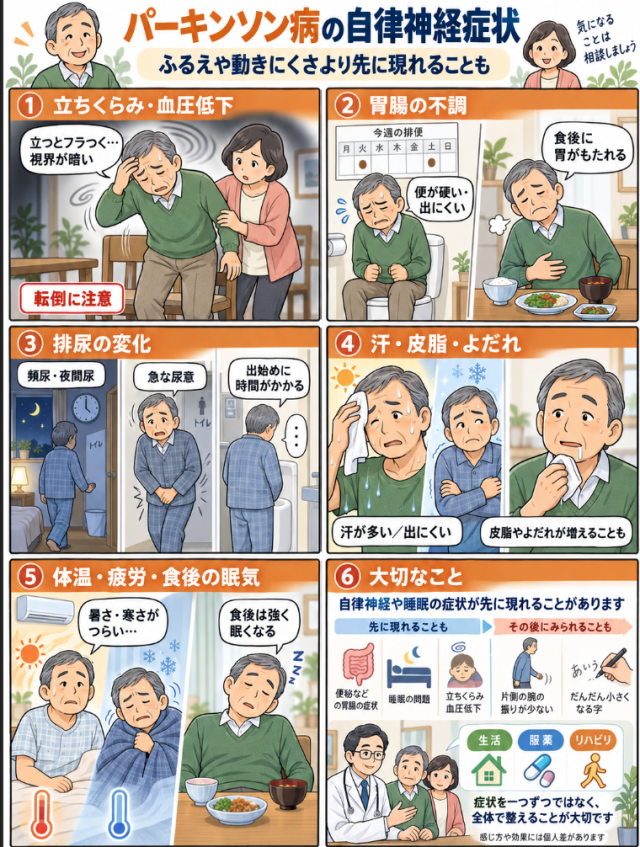
パーキンソン病では、心拍・血圧・発汗・消化・排尿・体温などを調整する自律神経のネットワークにも変化が及びます。脳幹の自律神経中枢(迷走神経背側核など)や末梢の自律神経節、腸管神経系に異常タンパク(αシヌクレイン)の蓄積が進むと、外からの刺激に対して“自動的に微調整する力”が鈍くなります。例えるなら、常に最適なアイドリング回転数を保つはずのエンジン管理コンピュータが、全体的に出力不足になっている状態です。
当院では、自律神経機能の客観評価として、コンデビュー(自律神経機能測定デバイス)を用いて心拍変動(HRV)由来の自律神経指数を定期的に記録しています。これまでに評価したパーキンソン病の方では、例外なく“自律神経のパワー(総合的な変動の大きさ)”が低値を示しました。具体的には、安静時の総パワー(Total Power)の低下や、交感・副交感の双方を反映する周波数帯の振幅低下が目立ち、起立負荷時の血圧調整も鈍い傾向が観察されます。数値は個人差がありますが、主観的な「立ちくらみ」「冷え」「発汗の出にくさ」「食後だるい」といった訴えと、客観的な“パワー低下”がよく一致します。
自律神経症状の具体例
・立ちくらみ・起立性低血圧(立位でフラつく、視界が暗くなる)
・便秘(週に2回以下、硬便、いきみが必要)や食後の胃もたれ
・頻尿・夜間尿、尿意切迫、排尿開始の遅れ
・発汗異常(汗が出にくい/出すぎる)、皮脂増加、涎(よだれ)
・体温調節の苦手さ、慢性疲労感、食後の強い眠気
重要なのは、これらが運動症状に先行して現れることが珍しくない点です。当院の印象でも、便秘や睡眠の異常、立ちくらみの自覚が先行し、後から片側の腕振り低下や小字症に気づくケースが見られます。自律神経の“土台の出力”を整えるアプローチ(生活・服薬・リハ)は、運動症状の体感にも波及しやすく、総合的なマネジメントが効果的です(効果には個人差があります)。
参考文献
[1] Gjerløff et al. (2015)
Imaging acetylcholinesterase density in peripheral organs in Parkinson’s disease with 11C-donepezil PET. Brain : a journal of neurology.
https://pubmed.ncbi.nlm.nih.gov/25539902/
[2] Haensch et al. (2009)
Cardiac denervation occurs independent of orthostatic hypotension and impaired heart rate variability in Parkinson’s disease. Parkinsonism & related disorders.
https://pubmed.ncbi.nlm.nih.gov/18515170/
[3] Fleming et al. (2013)
Impaired baroreflex function in mice overexpressing alpha-synuclein. Frontiers in neurology.
https://pubmed.ncbi.nlm.nih.gov/23888153/
[4] Haapaniemi et al. (2001)
Ambulatory ECG and analysis of heart rate variability in Parkinson’s disease. Journal of neurology, neurosurgery, and psychiatry.
https://pubmed.ncbi.nlm.nih.gov/11181850/
[5] Strano et al. (2016)
Cardiovascular dysfunction in untreated Parkinson’s disease: A multi-modality assessment. Journal of the neurological sciences.
https://pubmed.ncbi.nlm.nih.gov/27772769/
[6] Li et al. (2021)
Association Between Heart Rate Variability and Parkinson’s Disease: A Meta-analysis. Current pharmaceutical design.
https://pubmed.ncbi.nlm.nih.gov/32888281/
[7] Heimrich et al. (2021)
Heart Rate Variability Analyses in Parkinson’s Disease: A Systematic Review and Meta-Analysis. Brain sciences.
https://pubmed.ncbi.nlm.nih.gov/34439578/
[8] Stoco-Oliveira et al. (2021)
Parkinson’s disease effect on autonomic modulation: an analysis using geometric indices. Arquivos de neuro-psiquiatria.
https://pubmed.ncbi.nlm.nih.gov/33759977/
[9] Ruppert et al. (2025)
Deceleration Capacity as a Marker of Autonomic Cardiac Modulation in Prodromal and Manifest Parkinson’s Disease, Multiple System Atrophy, and Progressive Supranuclear Palsy. European journal of neurology.
https://pubmed.ncbi.nlm.nih.gov/41165053/
[10] Naranjo et al. (2021)
Short-term deceleration capacity of heart rate: a sensitive marker of cardiac autonomic dysfunction in idiopathic Parkinson’s disease. Clinical autonomic research : official journal of the Clinical Autonomic Research Society.
https://pubmed.ncbi.nlm.nih.gov/34251546/
[11] Valente et al. (2022)
Autonomic and cardiorespiratory responses to the active tilt test in individuals with Parkinson disease: cross-sectional study. Arquivos de neuro-psiquiatria.
https://pubmed.ncbi.nlm.nih.gov/36254441/
[12] Asahina et al. (2014)
Sudomotor and cardiovascular dysfunction in patients with early untreated Parkinson’s disease. Journal of Parkinson’s disease.
https://pubmed.ncbi.nlm.nih.gov/24577504/
[13] Oka et al. (2006)
Cardiovascular dysautonomia in de novo Parkinson’s disease. Journal of the neurological sciences.
https://pubmed.ncbi.nlm.nih.gov/16325862/
[14] Oka et al. (2011)
Cardiovascular dysautonomia in de novo Parkinson’s disease without orthostatic hypotension. European journal of neurology.
https://pubmed.ncbi.nlm.nih.gov/20602633/
[15] Valappil et al. (2010)
Exploring the electrocardiogram as a potential tool to screen for premotor Parkinson’s disease. Movement disorders : official journal of the Movement Disorder Society.
https://pubmed.ncbi.nlm.nih.gov/20976736/
[16] Malkiewicz and Siuda (2023)
Comparison of autonomic dysfunction in patients with Parkinson’s Disease, progressive supranuclear palsy, and multiple system atrophy. Neurologia i neurochirurgia polska.
https://pubmed.ncbi.nlm.nih.gov/38148738/
[17] Cersosimo and Benarroch (2012)
Autonomic involvement in Parkinson’s disease: pathology, pathophysiology, clinical features and possible peripheral biomarkers. Journal of the neurological sciences.
https://pubmed.ncbi.nlm.nih.gov/22001247/
[18] Alonso et al. (2015)
Heart rate variability and the risk of Parkinson disease: The Atherosclerosis Risk in Communities study. Annals of neurology.
https://pubmed.ncbi.nlm.nih.gov/25707861/
[19] Limotai et al. (2026)
Exploring cardiac autonomic dysfunction in synucleinopathies with parkinsonism through awake-sleep stages: a possible connection to cardiovascular death. BMJ neurology open.
https://pubmed.ncbi.nlm.nih.gov/41573095/
[20] Niwa et al. (2011)
Circadian rhythm of rest activity and autonomic nervous system activity at different stages in Parkinson’s disease. Autonomic neuroscience : basic & clinical.
https://pubmed.ncbi.nlm.nih.gov/21871844/
[21] Arnao et al. (2020)
Impaired circadian heart rate variability in Parkinson’s disease: a time-domain analysis in ambulatory setting. BMC neurology.
https://pubmed.ncbi.nlm.nih.gov/32326894/
[22] Pursiainen et al. (2002)
Circadian heart rate variability in Parkinson’s disease. Journal of neurology.
https://pubmed.ncbi.nlm.nih.gov/12420094/
[23] Ke et al. (2017)
Sympathetic skin response and heart rate variability in predicting autonomic disorders in patients with Parkinson disease. Medicine.
https://pubmed.ncbi.nlm.nih.gov/28471954/
[24] Pilipovich et al. (2025)
[Correlation of motor symptoms and cardiovascular dysfunction in Parkinson’s disease]. Zhurnal nevrologii i psikhiatrii imeni S.S. Korsakova.
https://pubmed.ncbi.nlm.nih.gov/40350730/
[25] Miyagi et al. (2022)
Power spectral analysis of heart rate variability is useful as a screening tool for detecting sympathetic and parasympathetic nervous dysfunctions in Parkinson’s disease. BMC neurology.
https://pubmed.ncbi.nlm.nih.gov/36088296/
早期から現れやすいサイン:嗅覚低下、便秘、睡眠の異常、気分の変化
パーキンソン病の“初期サイン”は、日常の些細な違和感として現れます。見逃さないコツは「片側から」「原因が思い当たらない」「3カ月以上続く」の3点です。
嗅覚低下
香水やシャンプーの香りが分かりにくい、料理の香ばしさを感じにくい。風邪でも花粉症でもないのに持続する場合は要注意です。
便秘・胃腸の不調
便が硬く回数が減る、排便に強いいきみが必要、腹部膨満感。食物繊維や水分で改善しにくい便秘は、腸の自律神経低下が背景にあることがあります。
睡眠の異常(レム睡眠行動障害を含む)
夢を見ている内容に合わせて手足を大きく動かす、叫ぶ/ベッドから落ちる、熟睡感が乏しい、日中の眠気。パートナーの証言がヒントになります。
気分・意欲の変化
抑うつ・不安・意欲低下(アパシー)。「理由なく気分が落ちる」「今まで楽しめたことに手が伸びない」。セロトニンやノルアドレナリンなど、ドーパミン以外の神経伝達にも影響が及ぶためです。
片側の運動の違和感
片側の腕振りが減る、ボタンかけが遅い、字が小さくなる、足が引っかかる。動画やメモで変化を記録すると、診察時に役立ちます。
これらのサインは単独では“ありふれた不調”に見えますが、組み合わさって持続する場合、神経内科への相談をお勧めします。早期相談の利点は、生活指導やリハビリを先手で始められること、将来の変化を見通した準備ができることです。
参考文献
[1] Schapira et al. (2017)
Non-motor features of Parkinson disease. Nature reviews. Neuroscience.
https://pubmed.ncbi.nlm.nih.gov/28592904/
[2] Tolosa et al. (2007)
The premotor phase of Parkinson’s disease. Parkinsonism & related disorders.
https://pubmed.ncbi.nlm.nih.gov/17681839/
[3] Chen et al. (2015)
Meta-analyses on prevalence of selected Parkinson’s nonmotor symptoms before and after diagnosis. Translational neurodegeneration.
https://pubmed.ncbi.nlm.nih.gov/25671103/
[4] Postuma and Berg (2016)
Advances in markers of prodromal Parkinson disease. Nature reviews. Neurology.
https://pubmed.ncbi.nlm.nih.gov/27786242/
[5] Khoo et al. (2013)
The spectrum of nonmotor symptoms in early Parkinson disease. Neurology.
https://pubmed.ncbi.nlm.nih.gov/23319473/
[6] Aguirre-Mardones et al. (2015)
Prevalence and timeline of nonmotor symptoms in idiopathic rapid eye movement sleep behavior disorder. Journal of neurology.
https://pubmed.ncbi.nlm.nih.gov/25929658/
[7] Iranzo et al. (2017)
Characterization of patients with longstanding idiopathic REM sleep behavior disorder. Neurology.
https://pubmed.ncbi.nlm.nih.gov/28615430/
[8] Mehndiratta et al. (2011)
Nonmotor symptom complex of Parkinson’s disease–an under-recognized entity. Tropical animal health and production.
https://pubmed.ncbi.nlm.nih.gov/21751608/
[9] Postuma et al. (2012)
Identifying prodromal Parkinson’s disease: pre-motor disorders in Parkinson’s disease. Movement disorders : official journal of the Movement Disorder Society.
https://pubmed.ncbi.nlm.nih.gov/22508280/
[10] Flores-Torres et al. (2024)
Identifying Individuals in the Prodromal Phase of Parkinson’s Disease: A Prospective Cohort Study. Annals of neurology.
https://pubmed.ncbi.nlm.nih.gov/39702948/
[11] Daalen et al. (2021)
Towards subgroup-specific risk estimates: A meta-analysis of longitudinal studies on olfactory dysfunction and risk of Parkinson’s disease. Parkinsonism & related disorders.
https://pubmed.ncbi.nlm.nih.gov/33487544/
[12] Woo et al. (2024)
Constipation is linked to accelerated cognitive and motor decline in isolated REM sleep behavior disorder. Parkinsonism & related disorders.
https://pubmed.ncbi.nlm.nih.gov/37524632/
[13] Chen et al. (2022)
REM sleep behavior disorder correlates with constipation in de novo Chinese Parkinson’s disease patients. Neurological sciences : official journal of the Italian Neurological Society and of the Italian Society of Clinical Neurophysiology.
https://pubmed.ncbi.nlm.nih.gov/36098886/
[14] Knudsen et al. (2019)
Objective intestinal function in patients with idiopathic REM sleep behavior disorder. Parkinsonism & related disorders.
https://pubmed.ncbi.nlm.nih.gov/30143390/
[15] Iranzo (2013)
Parkinson disease and sleep: sleep-wake changes in the premotor stage of Parkinson disease; impaired olfaction and other prodromal features. Current neurology and neuroscience reports.
https://pubmed.ncbi.nlm.nih.gov/23881622/
[16] Poewe (2008)
Non-motor symptoms in Parkinson’s disease. European journal of neurology.
https://pubmed.ncbi.nlm.nih.gov/18353132/
[17] Flores-Torres et al. (2021)
Cognitive function in men with non-motor features of Parkinson’s disease. BMJ neurology open.
https://pubmed.ncbi.nlm.nih.gov/34250483/
[18] Siderowf et al. (2012)
Impaired olfaction and other prodromal features in the Parkinson At-Risk Syndrome Study. Movement disorders : official journal of the Movement Disorder Society.
https://pubmed.ncbi.nlm.nih.gov/22237833/
[19] Hughes et al. (2021)
Non-Motor Features of Parkinson’s Disease in Women. Journal of Parkinson’s disease.
https://pubmed.ncbi.nlm.nih.gov/33935102/
[20] Hughes et al. (2018)
Non-motor features of Parkinson’s disease in a nested case-control study of US men. Journal of neurology, neurosurgery, and psychiatry.
https://pubmed.ncbi.nlm.nih.gov/30076266/
[21] Kulcsarova et al. (2021)
Comparison in detection of prodromal Parkinson’s disease patients using original and updated MDS research criteria in two independent cohorts. Parkinsonism & related disorders.
https://pubmed.ncbi.nlm.nih.gov/33964786/
[22] Pilotto et al. (2017)
Application of the movement disorder society prodromal Parkinson’s disease research criteria in 2 independent prospective cohorts. Movement disorders : official journal of the Movement Disorder Society.
https://pubmed.ncbi.nlm.nih.gov/28509336/
よくある勘違い・他疾患との違い:本態性振戦、加齢、筋力低下との鑑別
パーキンソン病を正しく見分けるには、“似て非なる”状態との違いを押さえることが重要です。
本態性振戦との違い
・典型:本態性振戦はコップを持つ・字を書くなど“動作中”のふるえが目立ち、左右対称的。家族歴があることも。パーキンソン病の振戦は“安静時”優位で、片側から始まることが多い。
・反応:アルコールで軽くなるのは本態性振戦に多く、パーキンソン病では一定せず、L-ドーパ反応性が診断の手がかりになります(反応には個人差)。
加齢・廃用(使わないことによる衰え)との違い
・加齢でも動きは遅くなりますが、パーキンソン病では“すばやい反復運動”が急に苦手に。片側の腕振り低下や小字症、仮面様顔貌は加齢だけでは説明しにくい所見です。
パーキンソン症候群・他の神経変性症
・多系統萎縮症(MSA):早期からの顕著な自律神経障害(重い起立性低血圧・排尿障害)が特徴で、心臓MIBGシンチは保たれることが多い。パーキンソン病ではMIBG低下が典型的です。
・進行性核上性麻痺(PSP):上方視の障害や早期からの後方転倒が目立つ。
・脳血管性パーキンソニズム:歩行が主で、上肢の所見が弱く、画像で血管病変を認める。
自己判断が難しい場合は、専門医の診察と必要な検査(後述)で総合的に評価します。
受診の目安と診断の流れ:医療機関で何を調べるか
「片側の動きが鈍い」「安静時に手が震える」「便秘・睡眠の異常が続く」といった症状が3カ月以上続く、または日常生活に支障が出てきたら受診の目安です。転倒や著しい立ちくらみ、睡眠中の大きな叫び・動作がある場合は早めの相談を。
診察と検査の実際
病歴と診察:左右差、無動・固縮・振戦、姿勢反射を詳細に評価。小字症や声量低下も手がかり。非運動症状(便秘、睡眠、気分、頻尿、立ちくらみ)の丁寧な聴取が重要です。
・画像・機能検査:必要に応じて脳MRIで他疾患除外、ドーパミントランスポーター画像(DAT-SPECT)で黒質線条体系の機能低下を示唆、心臓MIBGシンチで交感神経機能低下を支持。自律神経検査として起立試験や心拍変動解析(HRV)を行うことがあります。
・薬剤反応性の評価:L-ドーパ反応性は診断と今後の方針の参考になります(効果には個人差)。
参考文献
[1] Agarwal and Biagioni (2023)
Essential Tremor. StatPearls Publishing.
https://www.ncbi.nlm.nih.gov/books/n/statpearls/article-30563/
[2] Zafar and Yaddanapudi (2023)
Parkinson Disease. StatPearls Publishing.
https://www.ncbi.nlm.nih.gov/books/n/statpearls/article-26674/
[3] Reich (2020)
Does This Patient Have Parkinson Disease or Essential Tremor?. Clinics in geriatric medicine.
https://pubmed.ncbi.nlm.nih.gov/31733699/
[4] Berardelli et al. (2013)
EFNS/MDS-ES/ENS [corrected] recommendations for the diagnosis of Parkinson’s disease. European journal of neurology.
https://pubmed.ncbi.nlm.nih.gov/23279440/
[5] Watanabe et al. (2018)
[New Diagnostic Criteria for Parkinson’s Disease: MDS-PD Criteria]. Brain and nerve = Shinkei kenkyu no shinpo.
https://pubmed.ncbi.nlm.nih.gov/29433115/
[6] Bajaj et al. (2013)
Clinical utility of dopamine transporter single photon emission CT (DaT-SPECT) with (123I) ioflupane in diagnosis of parkinsonian syndromes. Journal of neurology, neurosurgery, and psychiatry.
https://pubmed.ncbi.nlm.nih.gov/23486993/
[7] Benamer et al. (2000)
Accurate differentiation of parkinsonism and essential tremor using visual assessment of [123I]-FP-CIT SPECT imaging: the [123I]-FP-CIT study group. Movement disorders : official journal of the Movement Disorder Society.
https://pubmed.ncbi.nlm.nih.gov/10830416/
[8] Bosquet et al. (2004)
[Differential diagnosis of parkinsonism using dopamine transporters brain SPECT]. Medicina clinica.
https://pubmed.ncbi.nlm.nih.gov/15033050/
[9] Novellino et al. (2009)
Combined use of DAT-SPECT and cardiac MIBG scintigraphy in mixed tremors. Movement disorders : official journal of the Movement Disorder Society.
https://pubmed.ncbi.nlm.nih.gov/19795467/
[10] Lee et al. (2006)
Cardiac 123I-MIBG scintigraphy in patients with essential tremor. Movement disorders : official journal of the Movement Disorder Society.
https://pubmed.ncbi.nlm.nih.gov/16671077/
[11] Shin et al. (2022)
Clinical Aspects of the Differential Diagnosis of Parkinson’s Disease and Parkinsonism. Journal of clinical neurology (Seoul, Korea).
https://pubmed.ncbi.nlm.nih.gov/35589315/
[12] Druschky et al. (2000)
Differentiation of Parkinson’s disease and multiple system atrophy in early disease stages by means of I-123-MIBG-SPECT. Journal of the neurological sciences.
https://pubmed.ncbi.nlm.nih.gov/10785250/
[13] Orimo et al. (2012)
123I-MIBG myocardial scintigraphy for differentiating Parkinson’s disease from other neurodegenerative parkinsonism: a systematic review and meta-analysis. Parkinsonism & related disorders.
https://pubmed.ncbi.nlm.nih.gov/22321865/
[14] Taki et al. (2004)
Significance of 123I-MIBG scintigraphy as a pathophysiological indicator in the assessment of Parkinson’s disease and related disorders: it can be a specific marker for Lewy body disease. Annals of nuclear medicine.
https://pubmed.ncbi.nlm.nih.gov/15515743/
[15] Shrimanker et al. (2022)
Parkinsonism. StatPearls Publishing.
https://www.ncbi.nlm.nih.gov/books/n/statpearls/article-26681/
[16] Shrimanker et al. (2022)
Parkinsonism. StatPearls Publishing.
https://www.ncbi.nlm.nih.gov/books/n/statpearls/article-26681/
[17] Contrafatto et al. (2012)
[(123) I]FP-CIT-SPECT asymmetry index to differentiate Parkinson’s disease from vascular parkinsonism. Acta neurologica Scandinavica.
https://pubmed.ncbi.nlm.nih.gov/21916850/
[18] Kalra et al. (2010)
Differentiating vascular parkinsonism from idiopathic Parkinson’s disease: a systematic review. Movement disorders : official journal of the Movement Disorder Society.
https://pubmed.ncbi.nlm.nih.gov/20077476/
[19] Zijlmans (2010)
The role of imaging in the diagnosis of vascular parkinsonism. Neuroimaging clinics of North America.
https://pubmed.ncbi.nlm.nih.gov/19959019/
[20] Ogawa et al. (2018)
Role of Neuroimaging on Differentiation of Parkinson’s Disease and Its Related Diseases. Yonago acta medica.
https://pubmed.ncbi.nlm.nih.gov/30275744/
[21] Pagano et al. (2016)
Imaging in Parkinson’s disease. Clinical medicine (London, England).
https://pubmed.ncbi.nlm.nih.gov/27481384/
[22] Uyama et al. (2017)
The utility of the combination of a SPECT study with [123I]-FP-CIT of dopamine transporters and [123I]-MIBG myocardial scintigraphy in differentiating Parkinson disease from other degenerative parkinsonian syndromes. Nuclear medicine communications.
https://pubmed.ncbi.nlm.nih.gov/28410288/
[23] Buchert et al. (2019)
Nuclear Imaging in the Diagnosis of Clinically Uncertain Parkinsonian Syndromes. Deutsches Arzteblatt international.
https://pubmed.ncbi.nlm.nih.gov/31774054/
[24] Leys et al. (2022)
The role of cardiovascular autonomic failure in the differential diagnosis of α-synucleinopathies. Neurological sciences : official journal of the Italian Neurological Society and of the Italian Society of Clinical Neurophysiology.
https://pubmed.ncbi.nlm.nih.gov/34817726/
まとめ:不安を感じたら、運動だけでなく自律神経の視点も
パーキンソン病は、運動機能の障害に加え、自律神経・睡眠・気分・嗅覚など全身のネットワークに影響する疾患です。当院でのコンデビューを用いた心拍変動解析では、パーキンソン病の方に共通して“自律神経のパワー低下”が観察され、主観的な立ちくらみ・便秘・発汗異常などと整合していました。だからこそ、症状の理解と対策は“全身視点”で行うことが大切です。
「片側の動きが鈍い」「安静時に手が震える」「便秘や睡眠の異常が続く」。そんなサインに心当たりがあれば、早めに神経内科へ。診断は段階的に進みますが、記録と客観指標を活用することで、あなたに合った“無理のないマネジメント”が組み立てられます。完璧を目指すのではなく、“今日できる一歩”を積み重ねていきましょう。
※当院は病院、クリニックではないためパーキンソン病であるかの診断はできません。お近くの神経内科またはパーキンソン病専門病院を受診ください。





パーキンソン病を根本から変える:土井治療院の統合的アプローチについて詳しくはこちら
この記事に関する関連記事
- パーキンソン病で甘いものは控えるべき?糖化・AGEsとの関係と食事の工夫
- パーキンソン病を公表した有名人・芸能人まとめ
- パーキンソン病の薬はいつから必要?治療開始のタイミング・効果と副作用を分かりやすく解説
- パーキンソン病に鍼(はり)治療は効果がある?「脳のゴミ掃除」と「自律神経」を整える科学的メカニズム
- パーキンソン病の原因となる食べ物は?「脳」ではなく「腸」をターゲットにした最新予防食事法
- パーキンソン病の初期症状とは?「手が震える」より前に気づくべきサインと根本からの予防策
- 『パーキンソン病になりやすい性格とは?「真面目で頑張りすぎる人」が注意したい脳の仕組みを専門家が解説』
- パーキンソン病の原因とは?~最先端研究で見えてきた「共犯説」とは
お電話ありがとうございます、
土井治療院でございます。